



Elysian (Li) Shiavitti, Service Valet
Our Service Valet, Elysian “Li” Shiavitti is always whipping up something delicious. For this week’s blog, we’re sharing a special recipe from Li’s Corner, which you can find in our monthly newsletter.
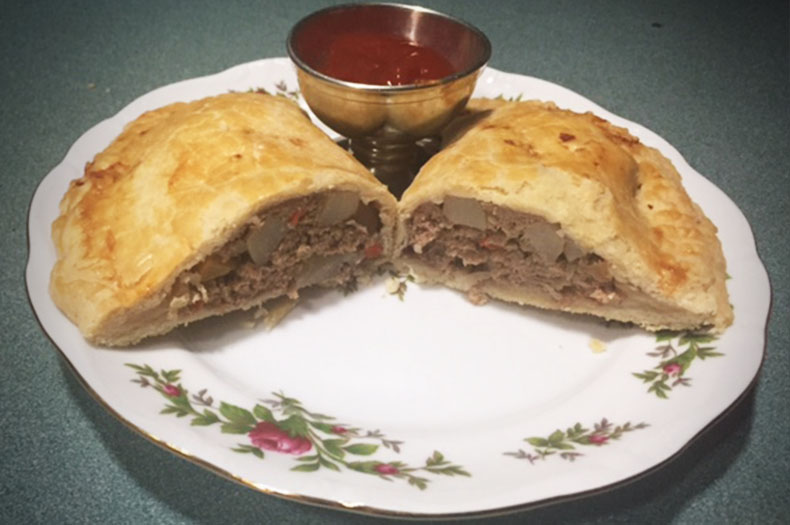
This month’s recipe is for the ever-so-delicious and family favorite Pasty (pronounced “Pass-tee”). I was born in the small town of Ironwood, located just 18 miles from Lake Superior and Canada on the upper peninsula of Michigan. My father worked in an iron ore mines and before he went to work, my Mother would make this delicious treat for his lunch.
My favorite place to buy pasties is Joe’s Pasty Shop, but my favorite place to get them is right in my mother’s kitchen. Everything she cooks is from memory and far from exact (A little of this, a pinch of that etc.), but my wife and I have begun to record her process. Some of these recipes are just too fantastic not to share, which brings us to this post. But first, I think it would be fun to go through a little bit of history:
The pasty’s origin can be traced back to Cornwall, England. Before leaving their homes to work in the tin mines, Cornish workers made a hot pasty. The miners placed this versatile food in their pockets, which provided both warmth and nourishment for the miner. The traditional pasty consisted of meat, potatoes, onions, seasoning (and in some cases turnips). All of which were wrapped in a crust and baked.
Because of the threat of arsenic poisoning, the miners often ate the “body” of the pasty, while discarding the “crimp,” or outer edge of the pasty, which they held with their dirty fingers. The miners believed, however, that the pasty crimp was not wasted but instead left to appease “knockers,” or ghosts, within the tunnels of the mines.
When the tin mining industry declined, Cornish miners immigrated to other parts of the world for other work. One of these areas was the Upper Peninsula of Michigan and parts of Wisconsin. It was here that Cornish miners worked in the copper and iron ore mines.
Other ethnic groups, including Finns, Italians, and Poles, adapted the pasty recipe to include ingredients that satisfied their tastes. While the recipe may vary among nationalities, it can be agreed upon that the pasty should contain potatoes and onions.
There are many recipes on the Internet but this is my mother’s (and I think the best).
Dough:
1 cup shortening (Crisco) or butter
3 cups flour
1 tsp salt
1/2 cup cold water – added as needed
(1 egg slightly beaten for glazing)
Filling:
1 lb ground beef
2 cups potatoes(small cubed) & 1 large onions grated.
1 carrot (small diced) 1/2 cup small cubed rutabaga
Season with salt & pepper to taste
Place the flour, Crisco and salt into a large clean bowl. Rub the Crisco into the flour with your fingertips until the mixture resembles fine breadcrumbs, working as quickly as possible to prevent the dough becoming warm. You could also cut shortening into flour with a pastry cutter, add the water to the mixture a little at a time until the dough binds together, add more cold water a teaspoon at a time if the mixture is too dry. Wrap the dough in Saran wrap/Cling film and chill for a minimum of 15 minutes, up to 30 minutes.
NOTE: The dough can also be made in a food processor by mixing the flour, shortening and salt in the bowl of the processor on a pulse setting. When the mixture resembles breadcrumbs, add the water, slowly, through the funnel until the dough comes together in a ball. Wrap in Saran wrap/ Clingfilm and chill as above.
Divide the pastry into 6 and roll each piece into rounds (approx 6 – 7 inches).
Place the filling mixture into a large mixing bowl and mix thoroughly.
Divide the meat mixture between each pasty circle and place in center of the circle. Brush half of the circle edges with a little beaten egg.
Fold the circle in half over the filling so the two edges meet. Seal and crimp the two edges together to create a tight seal. Brush each pasty top with the remaining beaten egg.
Place the pasties on a greased baking sheet and bake for 20 minutes at 400°, lower to 350° for 30 minutes or until golden brown,
Serve hot or cold with catsup.
![[Facebook]](https://www.continentaltoyota.com/blogs/725/wp-content/plugins/bookmarkify/facebook.png)
![[LinkedIn]](https://www.continentaltoyota.com/blogs/725/wp-content/plugins/bookmarkify/linkedin.png)
![[Twitter]](https://www.continentaltoyota.com/blogs/725/wp-content/plugins/bookmarkify/twitter.png)
![[Yahoo!]](https://www.continentaltoyota.com/blogs/725/wp-content/plugins/bookmarkify/yahoo.png)
![[Email]](https://www.continentaltoyota.com/blogs/725/wp-content/plugins/bookmarkify/email.png)
Connect with us


